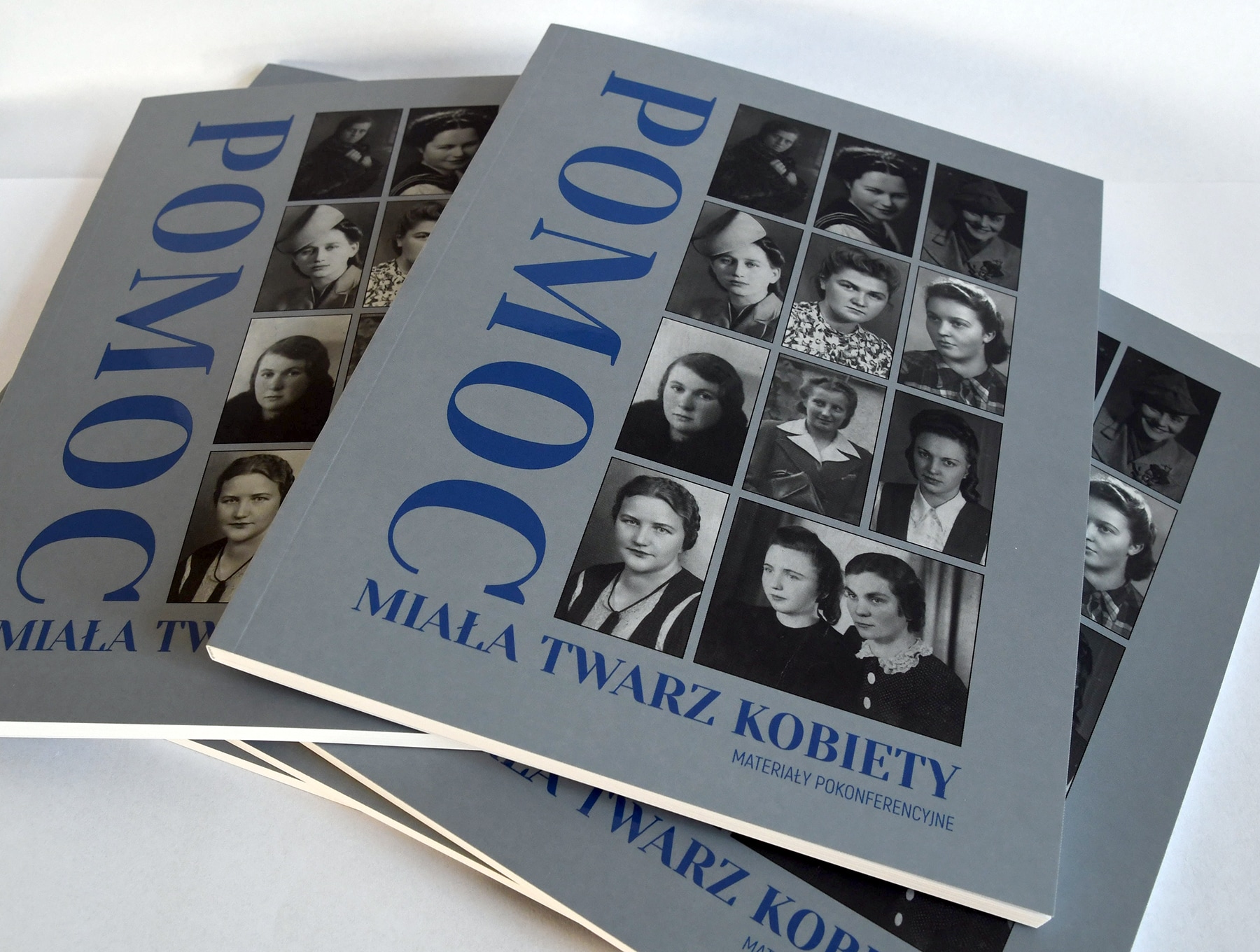
“Help had a woman’s face. Post-conference materials”* – is the latest book published by the Remembrance Museum.
The publication includes papers delivered at a conference organized by the Remembrance Museum and the International Center for Education about Auschwitz and the Holocaust.
“The content of the conference was chosen so that, after a cross-sectional view of the various forms of women’s involvement in the relief effort during World War II, we focus on local examples of women providing aid to Auschwitz prisoners,” said Remembrance Museum director Dorota Mleczko.
Dr. Anna Czocher, an employee of the Historical Research Office of the Institute of National Remembrance Branch in Krakow, in her text focused on the role of women in overt and clandestine aid activities during the German occupation of 1939-1945 in the General Government (the example of Krakow).
Dr. Jacek Lachendro, an employee of the Research Center of the Auschwitz-Birkenau State Museum, presented specific examples of aid to Auschwitz prisoners by women from the Brzeszcze municipality.
“Of the more than one thousand people from the Oświęcim area who were involved in activities on behalf of prisoners, nearly three hundred – including some 130 women – lived in the commune in question. Some of these 130 women provided assistance to Auschwitz escapees,” she points out at the beginning of her chapter.
The third text by Teresa Wontor-Cichy, an employee of the Auschwitz-Birkenau State Museum Research Center, is devoted to the figure of Zofia Gawron. In March 1943, as a 17-year-old, she was sent to Auschwitz for helping prisoners. She later played a key role in the operation to bring copies of German documents out of the camp.
“They were taken out of hiding only after the war ended and were later stored in the Gawron family home. Antonina Piatkowska came forward to retrieve them and gave the lists of dead Polish women, the results of anthropometric examinations and the photographs to Cardinal Sapieha of the “Caritas” organization, who then passed them on to Rev. Canon Jasieński,” writes Teresa Wontor-Cichy. The documents eventually made their way to the Chief Commission for Investigation of German Crimes.**
“I hope that this publication will inspire others to undertake further research, which will be a broader and in-depth analysis of the role of women in the deed of rendering aid,” concludes director Dorota Mleczko.
The Polish version of the book “Help had a Woman’s Face. Post-conference materials” can be purchased in the store on the first floor of the Remembrance Museum building at 2A Maksymiliana Kolbego Street in Oświęcim. It costs 20 zlotys.
Other books available
“A walk around Oświęcim. Photographs from the collection of Tadeusz Firczyk” (English and Polish versions available)
Andrzej Kacorzyk “The Great Journey of Ordinary People” (Polish only)
“Monuments, Memorials, commemorative plaques in the Municipality of Brzeszcze” edited by Jacek Lachendro (Polish only)
Stanisław Zasada “Kurierka” (Courier Girl, Polish only)
Jerzy Strzelecki “Topography Of Remembrance” (Polish and English versions available)
The shop is open during visiting hours: Tuesday-Sunday 10.00-16.00
* POMOC MIAŁA TWARZ KOBIETY. The English version of this book is in the process of being translated and the translation of the book title is yet to be decided. Subject to change.
** Chief Commission for the Prosecution of Crimes against the Polish Nation – Wikipedia