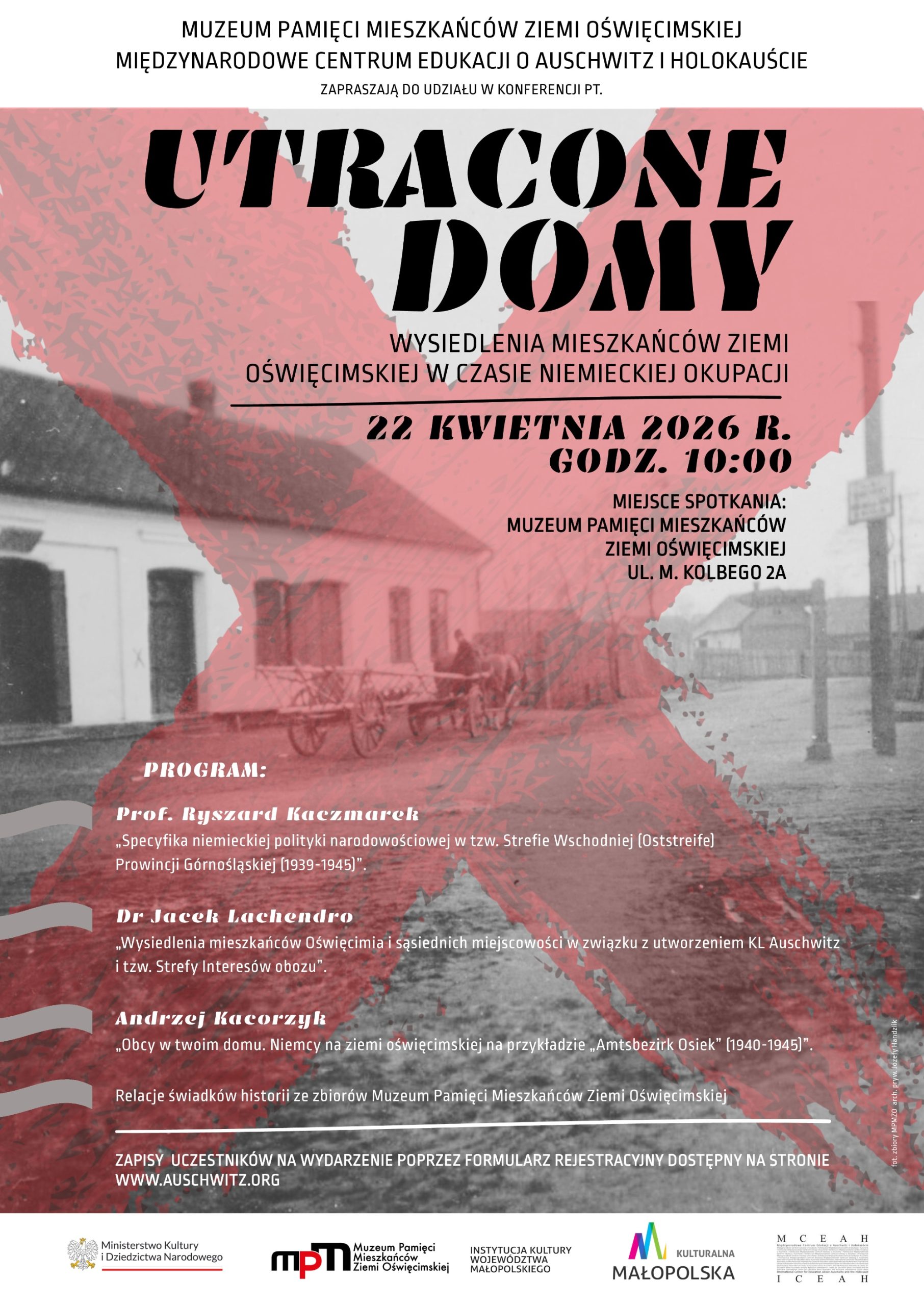

The Remembrance Museum of the Land of Oświęcim and the International Center for Education about Auschwitz and the Holocaust invite you to take part in the conference “Lost Homes”, devoted to the displacement of residents of the Oświęcim region during the German occupation. The conference will take place on April 22, 2026 (Wednesday) at 10:00 AM. Admission is free.
Displacement of local residents – historical background
Five years ago, during a joint educational session organized by the Museum and the International Center, Dr. Piotr Setkiewicz, Head of the Research Center of the Auschwitz-Birkenau State Museum, delivered a lecture on the displacement of residents of Oświęcim and nearby towns in the years 1940–1942. He emphasized the dramatic demographic consequences of German policies in the region:
“The demographic structure of Oświęcim changed dramatically—only one quarter of its pre-war population remained.”
Scale of destruction and depopulation
As a result of forced displacement and the demolition of residential buildings, villages near Oświęcim were almost entirely depopulated. For example, the Germans destroyed large parts of Broszkowice and approximately half of Babice. In Brzezinka, out of more than 500 houses, only six remained after the war, along with the school building and the fire station.
Witness testimonies – the human dimension
The course of the expulsions is reflected in testimonies preserved in the collection of The Remembrance Museum of the Land of Oświęcim.
Marian Górnicki (Oświęcim)
Marian Górnicki vividly recalled March 6, 1941:
We knew we would be displaced. It was March 6. Someone knocked on the door. My father got up and he saw three Germans with rifles. They asked if the Górnicki family lived there. My father said yes. My mother approached them and began speaking in German. One of the soldiers said, ‘We must be mistaken—you are German.’ ‘No, I am Polish,’ she replied. ‘So you’ve come for us.’ They didn’t even let us finish our meal. We had to get up immediately. They searched my father and took the money he had. We were taken to Kościuszko Square, where trucks were already waiting. They loaded us onto one and drove us toward the railway station. We were taken to the former Praga factory, now OMAG. There was straw spread across the hall. I remember it as if it were yesterday—people were talking: what will happen, where will we go? Guards with rifles stood at the doors. In the evening, people began singing a hymn. One of the guards said in Silesian: ‘Tell them to keep singing—they sing beautifully.’ At 10:00 PM, an officer came and shouted: ‘Silence! If we hear any noise, you will be punished.’ At 6:00 AM, a passenger train was brought to the siding. Families were called out from a list. When the train was full, it departed. It was freezing cold.”
Stanisława Smreczyńska (Brzeszcze)
After being displaced, Stanisława Smreczyńska and her family lived in someone else’s home until liberation in 1945:
“We were told to leave everything and go. We had to find somewhere to live. My mother couldn’t find anything. Brzeszcze was already full of displaced people from the camp area. Through relatives, we found a small house. We lived upstairs in a tiny room.”
Testimonies during the conference
Selected video testimonies from the Museum’s collection will also be presented during the conference.
Conference program – “Lost Homes”
Prof. Ryszard Kaczmarek “The Specific Nature of German Nationality Policy in the so-called Eastern Zone (Oststreife) of Upper Silesia Province (1939–1945)”
Dr. Jacek Lachendro “The Displacement of Residents of Oświęcim and Neighboring Areas in Connection with the Establishment of KL Auschwitz and the Camp’s ‘Zone of Interest’”
Andrzej Kacorzyk “Strangers in Your Home: Germans in the Oświęcim Region on the Example of ‘Amtsbezirk Osiek’ (1940–1945)”
The Remembrance Museum of the Land of Oświęcim
2A Maksymiliana Kolbego Street, Oświęcim
April 22, 2026 (Wednesday), 10:00 AM
Admission is free. Seating is limited.
Registration is required via the online form available at: www.auschwitz.org